VIOPUMPO Power Converters and Sump Backup Systems

VIOPUMPO makes two things that most homes eventually need: a reliable way to run 220V appliances on US power, and a pure sine wave backup system that keeps your sump pump running when the grid goes down. The voltage converter transformers handle bidirectional step-up and step-down automatically — no manual switching, no wrong-input mistakes. The sump backup systems switch to battery in 12 milliseconds and include a built-in 25A charger that keeps your battery ready without any attention from you. Every unit ships with a 12-month warranty.

✓ 12ms automatic switchover✓ Pure sine wave output✓ 12-month warranty
Check Price on Amazon
1000W Voltage Converter Transformer Step Up 110V/120V to220V/240V or Step Down 220V to 110V AC Power Converte
Pure Sine Wave Output Protects Motor Loads

Both sump backup models deliver pure sine wave AC — the same waveform your utility provides — which prevents the heat and premature motor wear that modified sine wave inverters cause in pump-driven loads.

12ms Grid-to-Battery Switchover, Automatic

When utility power cuts out, the sump backup system transfers to battery in 12 milliseconds — fast enough that a cycling pump won't miss a beat, even during storms where it's running every 10 minutes.

Reset a Tripped Breaker in One Press

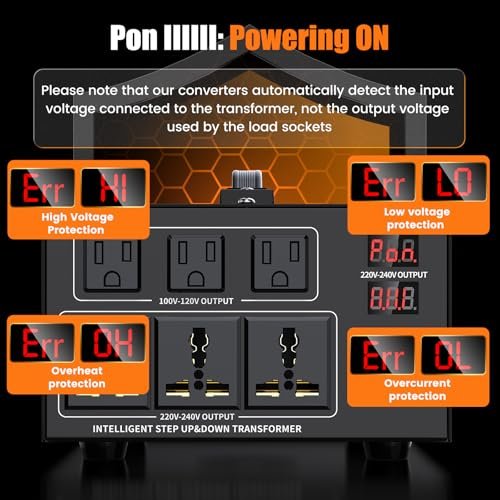
Every VIOPUMPO unit has a resettable circuit breaker and an LCD screen that shows the fault code — so you know exactly what tripped and can recover by pressing the FUSE button, not sourcing a replacement fuse.

25A Built-In Charger Keeps Batteries Ready

The sump backup systems include a 25A charger with fast and trickle modes, supporting AGM and deep-cycle lithium batteries — with overcharge protection built in so the battery stays healthy through months of standby.

VIOPUMPO Voltage Converter Transformers

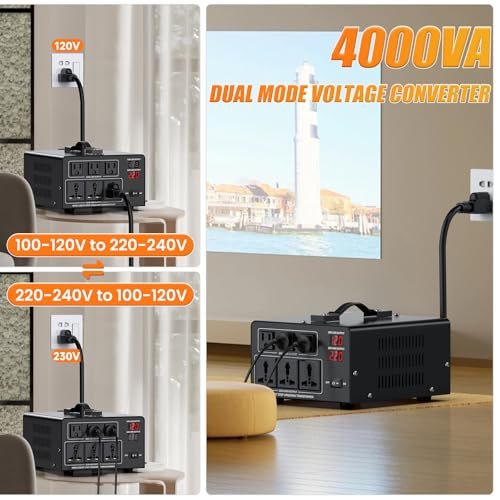
Both transformer models step voltage up from 110/120V to 220/240V — or back down — automatically, with no manual input switching required. Whether you're running a single 220V kitchen appliance or a professional tool on US power, the right model comes down to your load's wattage.

1000W Voltage Converter Transformer Step Up 110V/120V to220V/240V or Step Down 220V to 110V AC Power Converte

1000W Voltage Transformer

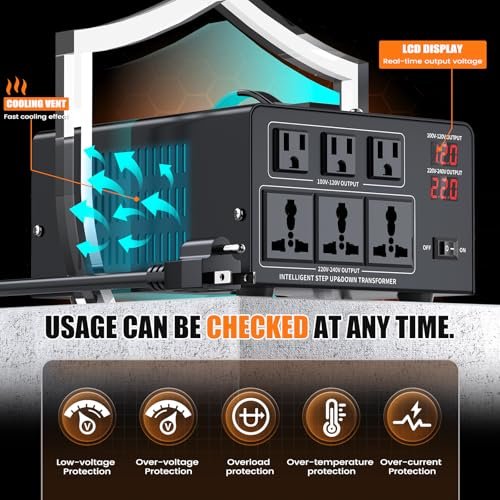
The entry-level transformer in the VIOPUMPO lineup handles continuous loads up to 1,000W — which means you should run appliances drawing no more than 800W at any given time. Four outlets (2 US, 2 universal), automatic voltage recognition, LCD fault display, and a resettable breaker are all standard.

Best for running a single 220V appliance — a kitchen mixer, hair dryer, or small audio component — without a manual input selector to worry about.

See on Amazon
2000W Voltage Converter Transformer Step Up 110V/120V to220V/240V or Step Down 220V to 110V AC Power Converte

2000W Voltage Transformer

Double the headroom of the 1000W model: the 2000W transformer handles continuous loads up to 2,000W, with a comfortable operating range up to 1,600W under the 80% rule. Same 4-outlet configuration, same automatic voltage recognition and LCD fault display — just room for larger appliances or two devices running simultaneously.

The right choice for 220V kitchen equipment, power tools, or professional audio gear that would push the 1000W model to its limit.

See on Amazon
2000 Watt sump pump backup battery system

2000W Sump Backup System

The 2000W system delivers 2,000W continuous and 4,000W peak pure sine wave output — enough surge headroom for most residential ½ HP to ¾ HP sump pumps, which typically run at 350–750W and spike under 2,100W at startup. The 25A charger, remote LCD, and 12ms switchover are identical to the flagship model. Battery not included.

The practical choice for most homeowners with a standard residential sump pump who don't need the extra 500W of continuous headroom the 2500W provides.

See on Amazon
2500 Watt Sump Pump Backup Battery System

2500W Sump Backup System

The flagship sump backup system — 2,500W continuous and 5,000W peak pure sine wave output — rated 4.8 out of 5 stars across 53 reviews, the strongest reception in the VIOPUMPO lineup. The larger surge ceiling handles higher-draw pumps and dual-pump setups without straining. Same 25A charger, remote LCD controller, and wall-mount or flat-install options as the 2000W model. Battery not included.

Worth the step up if you have a high-water-table property, a pump larger than ¾ HP, or you simply want the maximum surge headroom available in this category.

See on Amazon
Egg Incubator for Hatching 48-132 Chicken/Quail/Turkey Eggs

48–132 Egg Incubator

A fully automatic incubator that handles 48 chicken, 36 duck, 16 goose, 16 turkey, or up to 132 quail eggs with adjustable trays. Six auto-turning intervals (60–210 minutes), a humidity alarm, A+B external water inlets for mid-cycle top-up without opening the lid, and a built-in egg candler. Weighs 8.4 lbs; measures 19×18.5×8 inches. Comes with a 30-day money-back guarantee and 2-year limited warranty.

Built for backyard chicken keepers and hobbyist farmers who want automated turning and humidity control without buying a separate candler — and a longer warranty than most incubators in this category carry.

See on Amazon

How to Size Your VIOPUMPO for Your Load

Getting the wattage right before you buy prevents the most common failure scenario with both product lines. For transformers, the rule is simple: never run them above 80% of rated capacity. For sump backup systems, startup surge is the number that actually determines whether your pump starts when the grid goes dark.

VIOPUMPO - 1000W Voltage Converter Transformer Step Up 110V/120V to220V/240V or Step Down 220V to 110V AC Power Converte

The 80% Rule for Voltage Transformer Models

The 1000W Voltage Transformer can handle a maximum of 800W continuously — not 1,000W. Run it at or near its ceiling and it will run warm, trip more frequently, and wear out faster. Run it at 700W and it barely notices the load. Same math applies to the 2000W model: continuous loads up to 1,600W, not 2,000W.

Here's why this matters in practice. Say you're bringing a 220V espresso machine rated at 1,400W from Europe. On paper, the 1000W transformer is nowhere near enough — but neither is running the 2000W unit at 87% capacity under repeated daily use. The 2000W model at a 1,400W load is within the 80% ceiling (1,400 ÷ 2,000 = 70%), so that's the right call. Picking a transformer that puts your appliance near 60–70% of rated wattage is better than one that runs it near 80%.

If you don't know your appliance's wattage, check the nameplate — usually on the bottom or back. It will list either watts directly or volts × amps, which gives you the same number. When in doubt, size up.

Surge Power and Why It Matters for Sump Pumps

Motor-driven loads don't start quietly. A sump pump that runs at 600W under normal operation can draw 1,500–1,800W for the first half-second at startup. That startup surge — sometimes called inrush current — is the number your inverter has to handle, not the nameplate running wattage.

Both VIOPUMPO sump backup models publish separate continuous and peak ratings for exactly this reason:

  • The 2000W Sump Backup System delivers 2,000W continuous and 4,000W peak
  • The 2500W Sump Backup System delivers 2,500W continuous and 5,000W peak

A 3/4 HP residential sump pump typically runs at 550–750W and surges to roughly 1,500–2,100W at startup. Both models handle that comfortably. Where the 2500W model earns its place is with larger 1 HP pumps (which can surge above 2,800W) or setups running two pumps — a primary and a backup — simultaneously. If your pump is a standard 1/2 HP or 3/4 HP unit and you're not running anything else off the inverter, the 2000W model has enough headroom.

One thing worth saying plainly: if you're not sure of your pump's HP rating, look at the label on the pump motor itself. Don't guess. An undersized inverter won't damage your pump outright — it'll just fail to start it, which is the worst possible outcome at 2 a.m. during a storm.

Calculating Runtime Before You Buy a Battery

Both sump backup systems ship without a battery. That means runtime is entirely in your hands — which is actually useful, because you can size the battery to match your pump's duty cycle rather than accepting whatever a pre-bundled battery gives you.

The formula: Battery capacity (Ah) × 12V × inverter efficiency ÷ pump running wattage = approximate runtime in hours.

VIOPUMPO's sump backup systems run at roughly 85–90% efficiency, so use 0.87 as your multiplier. A 100Ah AGM battery paired with the 2000W system running a 600W pump gives you approximately: 100 × 12 × 0.87 ÷ 600 = 1.74 hours of continuous pumping. But sump pumps don't run continuously — they cycle. A pump that runs 3 minutes on and 7 minutes off is only drawing power 30% of the time, which triples your effective runtime to roughly 5 hours from that same 100Ah battery.

High-water-table properties where the pump cycles every 5–10 minutes during a storm need either a larger battery (150Ah or 200Ah AGM) or a LiFePO4 battery with the same nominal Ah rating but more usable capacity. More on that in the battery selection section below.

Choosing a Battery for Your Sump Backup

The VIOPUMPO sump backup systems are the controller — the inverter, charger, and switchover logic in one unit. The battery is the fuel tank, and you supply it. That separation matters because the right battery depends on your pump's behavior, your budget, and how long you want to go between replacements.

AGM vs. LiFePO4 at a Glance

Both battery types work with VIOPUMPO's built-in 25A charger. The charger supports fast charging and trickle charging for AGM and deep-cycle lithium — overcharge protection is built in, so the battery won't be damaged during long standby periods. What the charger doesn't support is standard automotive (non-deep-cycle) batteries. Don't use those — they'll fail quickly in this application because they're not designed for the deep discharge and recharge cycles a sump backup puts them through.

VIOPUMPO - 1000W Voltage Converter Transformer Step Up 110V/120V to220V/240V or Step Down 220V to 110V AC Power Converte

Here's how AGM and LiFePO4 compare on the factors that actually matter for this use case:

  • Cost: AGM is significantly cheaper upfront. A 100Ah AGM battery typically runs a fraction of the cost of a comparable LiFePO4 unit. If budget is the primary constraint, AGM is the practical starting point.
  • Weight: A 100Ah AGM battery weighs roughly 60–65 lbs. A 100Ah LiFePO4 battery weighs around 26–30 lbs. If the unit is wall-mounted in a tight utility room, that weight difference is real.
  • Cycle life: AGM batteries typically handle 300–500 deep discharge cycles before capacity drops noticeably. LiFePO4 batteries are rated for 2,000–3,000 cycles under the same conditions. In a sump backup application that rarely discharges fully, both last longer than their cycle ratings suggest — but LiFePO4 wins on longevity by a wide margin.
  • Usable capacity: AGM batteries shouldn't be discharged below 50% of their rated capacity without accelerating degradation. So a 100Ah AGM gives you about 50Ah of usable energy. LiFePO4 can discharge to 80–90% depth without damage, meaning a 100Ah LiFePO4 delivers roughly 80–90Ah of usable capacity. That's a meaningful runtime difference from the same nominal size.
  • Self-discharge during standby: AGM loses roughly 3–5% of charge per month sitting idle. LiFePO4 loses less than 2% per month. VIOPUMPO's trickle charging mode keeps either battery topped off during standby — but LiFePO4 needs less intervention to stay healthy.

What Size Battery Do You Actually Need

Start with your pump's running wattage and your expected outage duration. Most residential power outages during storms last 2–8 hours. A few last longer.

For a 1/2 HP pump running at roughly 400–500W with a moderate duty cycle (4 minutes on, 6 minutes off), a 75Ah AGM battery provides approximately 3–4 hours of coverage. A 100Ah AGM gets you to 5–6 hours. Stepping up to a 150Ah AGM or a 100Ah LiFePO4 extends that to 8+ hours — enough for most storm-driven outages.

If your area loses power for 12+ hours during severe weather and your basement is flood-prone, a 200Ah AGM or a 100–150Ah LiFePO4 is worth the investment. Community data from sump backup users on r/prepping describes pumps cycling over 100 times across a 12-hour outage — that kind of sustained use demands a battery sized for the real worst case, not the average case.

One Thing to Watch With LiFePO4

Some LiFePO4 batteries include a built-in battery management system (BMS) that requires the charger to communicate specific charge profiles. VIOPUMPO's 25A charger works with deep-cycle lithium batteries, but confirm with your LiFePO4 battery's documentation that it accepts a standard 14.4–14.6V bulk charge voltage. Most LiFePO4 batteries sold for solar and backup applications do — but some cells marketed as "smart" batteries with proprietary BMS communication may not. When in doubt, AGM is the simpler, more predictable choice for a first installation.

Battery terminals matter too. Both VIOPUMPO sump backup systems use standard DC cable connections — make sure your battery has accessible threaded terminals and that your cable gauge matches the DC current draw at the inverter's output capacity. The included cables are sized for the unit; don't substitute thinner wire.

Which VIOPUMPO Model Fits Your Setup

Both product lines have two models each, and the difference between them is wattage headroom — not features. Every protection function, every display, every charger spec is identical between the 1000W and 2000W transformers, and between the 2000W and 2500W sump backup systems. The only question is whether your load fits comfortably inside the smaller unit's ceiling.

For Voltage Converter Transformer Buyers

Start with your appliance's wattage. That number is on the nameplate — usually the bottom or back panel. If it shows amps and volts instead of watts, multiply them together.

Then apply the 80% rule: your load must stay at or below 80% of the transformer's rated wattage for safe continuous operation.

VIOPUMPO - 1000W Voltage Converter Transformer Step Up 110V/120V to220V/240V or Step Down 220V to 110V AC Power Converte
  • Load under 800W → 1000W Voltage Transformer. Single appliances like a 220V hair dryer, a small kitchen mixer, a European power tool rated under 800W, or a desktop computer from abroad. The 1000W model handles one device at a time at this load level without issue.
  • Load between 800W and 1,600W → 2000W Voltage Transformer. This covers larger kitchen appliances — a 220V induction cooktop, a stand mixer with a heating element, a professional espresso machine — or two smaller appliances running simultaneously. The 2000W model also gives you breathing room if your appliance draws more at startup than its nameplate suggests, which is common with anything that has a heating coil or motor.
  • Load above 1,600W → size up beyond this line or run dedicated circuits. Neither transformer model is designed for sustained loads above its 80% ceiling. If you're running a 220V washer or electric oven, you're in a different wattage category.

One practical note: don't try to run multiple appliances through a single transformer by summing their wattages and hoping you land under the ceiling. Startup surges stack, and simultaneous use is harder to predict than sequential use. If you regularly need two appliances at once, the 2000W model with comfortable headroom is the right call — not the 1000W model running near its limit.

For Sump Pump Backup System Buyers

Find your pump's horsepower rating — it's on the motor housing. Then map it to the system that gives you adequate surge headroom.

  • 1/3 HP pump (runs at ~300W, surges to ~900W) → 2000W Sump Backup System. The 4,000W peak rating has more than four times the headroom needed for startup. Clean fit.
  • 1/2 HP pump (runs at ~400–500W, surges to ~1,200–1,500W) → 2000W Sump Backup System. Still well within the 4,000W peak. The 2000W continuous rating gives you room to run the pump and a small light simultaneously if needed.
  • 3/4 HP pump (runs at ~550–750W, surges to ~1,600–2,100W) → either model works; 2500W preferred. The 2000W system's 4,000W peak technically covers this, but if your pump is on the high end of the 3/4 HP range or cycles very frequently, the 2500W system's 5,000W peak gives you more cushion. Choose the 2500W if you've ever had your current inverter or generator fail to start this pump.
  • 1 HP pump (runs at ~750–900W, surges to ~2,200–2,700W) → 2500W Sump Backup System. The 5,000W peak rating handles the startup draw. The 2000W model's 4,000W peak is marginal for this range — don't count on it.
  • Dual-pump setup (primary + backup pump on the same system) → 2500W Sump Backup System, and only if the combined surge draw stays under 5,000W. This is an edge case. If both pumps can start simultaneously, add their surge wattages and confirm the total is below 5,000W. If it isn't, you need a larger inverter from a different product category.

One Scenario Where Neither Model Is the Right Answer

If your sump pit cycles more than once every few minutes during a peak storm event and you're in an area that routinely loses power for 18–24 hours, no inverter system solves the problem alone — battery capacity becomes the constraint, not the inverter's wattage. In that situation, the right answer is a larger battery bank paired with the 2500W system, not a more powerful inverter.

Honest version: the VIOPUMPO sump backup systems are the right solution for the majority of residential basement flood-prevention scenarios. They're not the right solution for commercial sump applications, 2 HP industrial pumps, or situations where the pump runs continuously for hours at a time without pause. Knowing that boundary before you buy is more useful than finding out after.

Warranty Coverage and What Happens After

Every VIOPUMPO voltage transformer and sump backup system ships with a 12-month manufacturer warranty. That's a concrete, stated commitment — not dependent on registration windows, original packaging requirements, or fine-print conditions buried in documentation. The egg incubator carries a different warranty structure: a 30-day money-back guarantee plus a 2-year limited warranty with lifetime technical support.

What the 12-Month Warranty Covers

The warranty applies to manufacturing defects in the inverter-charger unit itself — the electronics, the housing, the built-in protection circuits. It covers the inverter, not the battery you pair with it. That distinction matters because batteries degrade on their own timeline regardless of inverter quality, and battery replacement is a normal part of maintaining a sump backup system over time.

If you run into a problem, VIOPUMPO's listed support channel is email — no phone line is published. For issues during the warranty period, document the fault code displayed on the LCD before contacting support. That code tells the support team exactly which protection function triggered and significantly speeds up any diagnosis or replacement process.

Reading the LCD Fault Codes

Both product lines include LCD displays that show fault codes when a protection function trips. This isn't just a status light — it's diagnostic information you can act on without a service call.

On the voltage transformer models, the LCD shows input voltage during normal operation and switches to a fault code when the unit trips. The manual maps each code to a specific cause: overcurrent, overload, overheating, short circuit. The fix for most of these is the same: disconnect the load, let the unit cool for a few minutes if overheating is involved, press the "FUSE" button on the back to reset the circuit breaker, then reconnect and restart at a lower load.

On the sump backup systems, the remote LCD controller shows voltage, power output, and battery charge status in real time. During normal standby on grid power, you'll see the battery charge level. When the grid fails and the unit switches to battery, the display shows output power so you can confirm the pump is drawing what you expect. A fault code during backup operation tells you whether the problem is low battery voltage, an overload condition, or a protection circuit trigger.

The short version: if something shuts off, look at the screen before assuming the unit is broken. Nine times out of ten, the screen tells you exactly what happened.

Battery Replacement Timeline

The inverter unit itself should last well beyond the warranty period under normal use. The battery is the consumable in this system.

AGM batteries in sump backup applications typically last 3–5 years before capacity degrades enough to reduce runtime noticeably. A battery that provided 6 hours of pump coverage when new might deliver only 3.5 hours after 4 years of standby cycling. LiFePO4 batteries, rated for 2,000–3,000 deep discharge cycles, last significantly longer — 8–12 years is realistic in a sump backup application where full discharges are rare.

VIOPUMPO's built-in trickle charging mode helps extend battery life during standby. A battery held at full charge — rather than left to slowly self-discharge — degrades more slowly. You don't need to babysit this: the 25A charger with overcharge protection handles the maintenance automatically once connected.

One practical thing to do regardless of battery type: test the system annually. Disconnect the AC input briefly and confirm the unit switches to battery power within the expected window, the pump starts normally, and the LCD shows reasonable voltage and output numbers. Batteries that fail silently — holding a surface charge but unable to deliver current under load — are the most common reason sump backup systems fail when they're actually needed. A 5-minute annual test eliminates that risk.

A Brutally Honest Look at Our 2500W System

We picked this walkthrough because Skinner's 100% Honest Reviews does exactly what the channel name says — no sponsored softening, no skipping the parts that matter. You'll get a real-world look at the 2500W sump backup system from someone who bought it, set it up, and tells you what he actually thinks. If you're still deciding between the 2000W and 2500W models, watch this before you add anything to your cart.

How VIOPUMPO Models Stack Up Side by Side

Both product lines come in two wattage tiers, and the right choice depends entirely on your load — not on which number sounds bigger. These tables cut through the spec-sheet noise and show exactly what differs between models in each category.

VIOPUMPO Voltage Converter Transformer Comparison

Feature1000W Voltage Transformer2000W Voltage Transformer
Continuous capacity1,000W2,000W
Safe continuous load (80% rule)800W1,600W
DirectionBidirectional (step-up and step-down)Bidirectional (step-up and step-down)
Voltage conversion110/120V ↔ 220/240V110/120V ↔ 220/240V
Outlet configuration2 US + 2 universal2 US + 2 universal
Voltage recognitionAutomatic (no manual switch)Automatic (no manual switch)
LCD displayInput voltage + fault codesInput voltage + fault codes
Circuit breakerResettable (press FUSE button)Resettable (press FUSE button)
Warranty12 months12 months

For a single 220V appliance drawing under 800W — a kitchen stand mixer, a hair dryer, a laptop charger — the 1000W model handles it cleanly. Step up to the 2000W if you're running larger kitchen equipment (an espresso machine, an induction cooktop, a professional audio receiver) or want headroom for two devices simultaneously. Both behave identically in every other respect: same automatic voltage recognition, same resettable breaker, same LCD fault-code display.

VIOPUMPO Sump Pump Backup Battery System Comparison

Feature2500W Sump Backup System2000W Sump Backup System
Continuous output2,500W2,000W
Peak (surge) output5,000W4,000W
Output waveformPure sine wavePure sine wave
AC output voltage110V–120V110V–120V
DC input range10V–15.5V10V–15.5V
Built-in charger25A (fast + trickle)25A (fast + trickle)
Battery compatibilityAGM, deep-cycle lithium, LiFePO4AGM, deep-cycle lithium, LiFePO4
Switchover time12ms automatic12ms automatic
Remote LCD controllerVoltage, power, battery charge statusVoltage, power, battery charge status
InstallationFlat or wall-mount (side fixing holes)Flat or wall-mount (side fixing holes)
Rating (Amazon)4.8/5 (53 reviews)4.7/5 (21 reviews)
Warranty12 months12 months

Most ½ HP to ¾ HP residential sump pumps run at 350–750W and surge to roughly 1,500–2,100W at startup — both models handle that range with headroom to spare. The 2000W Sump Backup System is the practical choice for a standard single-pump setup in a typical basement. Go with the 2500W if your pump is rated at 1 HP or above, if you're in a high-water-table area where the pump cycles hard during storms, or if you simply want the largest surge cushion available. Battery is not included with either model — you supply your own AGM or deep-cycle lithium.

Real Buyers on VIOPUMPO After the Storm

"We lost power for six hours during a heavy rain event last spring and the 2500W backup kept our sump running the whole time. The switchover was genuinely silent — I only knew it had happened because I checked the LCD remote. My only gripe is that the oversized plug on our pump barely fits in one of the outlets. Grab a short extension cord and you're fine."
— Mark T., Homeowner in a flood-prone area, Columbus OH
"I moved from Germany and brought a 220V espresso machine that I wasn't about to replace. The 2000W transformer handles it every morning without a hiccup. What I actually appreciate is the LCD showing the input voltage — I can see it's reading correctly instead of just hoping. The auto voltage recognition means I never have to think about it."
— Ingrid S., International resident adapting European appliances for US power
"Did my homework on VEVOR and VIOPUMPO before buying. The 25A built-in charger versus VEVOR's 20A was the tiebreaker for me — I wanted the battery staying fully conditioned during the months between storms. Install took maybe 20 minutes. The wall-mount option worked perfectly in my utility room. Not a flashy product, which is exactly what I wanted."
— Derek W., DIYer who compared specs before purchasing the 2500W Sump Backup System
"Running a 100Ah AGM paired with the 2000W system. During our last outage the pump cycled probably 40–50 times over four hours and the battery was still showing good charge on the remote LCD when power came back. The trickle charge mode means I don't think about battery maintenance at all between events."
— Carolyn B., Homeowner managing an active sump pump in a wet climate
"I use the 1000W transformer to run a professional-grade soldering station that only comes in 220V. It handles the load fine and the resettable breaker saved me once when I plugged in too much — pressed the FUSE button and was back running in 30 seconds. Would have been a nightmare if I'd had to track down a replacement fuse. Four stars, not five, because the manual could be clearer."
— Ray M., Electronics hobbyist and home workshop owner
"Part of a broader backup power setup — generator, battery bank, the works. The VIOPUMPO sump backup fits into the system cleanly. LiFePO4 compatibility matters for me because I don't want AGM weight in a utility shelf. The remote LCD is genuinely useful — I can check battery status from across the room. Battery lifespan is the real long-term question in this category and nobody can answer that yet for my specific setup."
— Phil C., Home resilience planner building out a multi-device backup system

Questions Buyers Ask Before Choosing VIOPUMPO

Will a 2000W inverter run a sump pump?

Yes — the VIOPUMPO 2000W Sump Backup System delivers 2,000W continuous and 4,000W peak pure sine wave output, which covers most residential ½ HP to ¾ HP sump pumps. A ¾ HP pump typically runs at 550–750W but can surge to 1,800–2,100W at startup. The 4,000W peak handles that margin comfortably. For 1 HP pumps or heavy-cycling applications, consider the 2500W model instead.

What is the 80% rule for transformers?

Never load a transformer beyond 80% of its rated wattage continuously. The VIOPUMPO 2000W Voltage Transformer, for example, should carry no more than 1,600W of continuous load. A 1,800W appliance belongs on the 2000W unit only if it draws less than 1,600W at steady state — check the nameplate. Running at or near 100% capacity generates excess heat and will trip the circuit breaker repeatedly.

Are battery backup sump pumps worth it?

For homes in flood-prone areas, yes — the math is straightforward. A single basement flood averages $10,000–$15,000 in damage. A sump backup system is a fraction of that. Community data from r/prepping documents a backup system running a pump through 12 hours of storms with the pump cycling over 100 times without a missed beat. The system works exactly when a primary pump is most vulnerable: when the grid is down and water is rising.

What is the lifespan of a sump pump battery backup?

The inverter unit itself should last well beyond five years with normal use. The battery is the consumable: AGM batteries typically need replacement every 3–5 years depending on cycle depth and how well the charger maintains them. LiFePO4 batteries last significantly longer — often 8–10 years — at higher upfront cost. VIOPUMPO's built-in 25A charger with trickle mode keeps AGM batteries conditioned during long standby periods, which extends their usable life.

Are AGM batteries worth it for a backup sump pump?

AGM is the practical default for most homeowners: widely available at home improvement stores, no special handling required, spill-proof, and compatible with VIOPUMPO's 25A built-in charger. LiFePO4 offers a longer cycle life and lighter weight but costs more upfront and requires confirming charger compatibility. Both work with the VIOPUMPO 2000W and 2500W Sump Backup Systems. Standard automotive batteries are not appropriate — they're not deep-cycle and will fail quickly in this application.

What is the difference between a voltage converter and a transformer?

In everyday use, the terms overlap. A transformer uses electromagnetic induction to change voltage — it's the core technology inside most voltage converters. A "voltage converter" is the broader consumer product category, which may include a transformer plus additional circuitry for safety and regulation. VIOPUMPO's converter line uses transformer-based technology with added protections (overcurrent, overheat, short circuit) and automatic voltage recognition — making them transformer-based converters in the practical sense.

Can you step up 110V to 220V?

Yes. Both VIOPUMPO transformer models — the 1000W Voltage Transformer and 2000W Voltage Transformer — step voltage up from 110/120V to 220/240V and back down automatically. The automatic voltage recognition means the unit detects which direction is needed and configures itself accordingly. There's no manual switch to set. Choose the model based on your appliance's wattage, keeping the 80% loading rule in mind.

Is a step-up transformer AC or DC?

Step-up transformers operate exclusively on AC (alternating current). Transformer operation depends on a changing magnetic field, which only AC provides — DC produces a constant field that doesn't induce voltage change across the coil. VIOPUMPO's transformer line steps up or down standard AC wall power (110/120V or 220/240V). They do not convert AC to DC or work with DC power sources.

What battery types work with VIOPUMPO sump backup systems?

The VIOPUMPO 2000W and 2500W Sump Backup Systems support AGM batteries, deep-cycle lithium batteries, and LiFePO4 batteries. The built-in 25A charger handles fast and trickle charging for all three types, with overcharge protection that prevents battery damage during long standby. Standard non-deep-cycle car batteries are not compatible — the charge profile and discharge demands of a sump backup application will damage them quickly.

How do I know if a transformer will handle my appliance?

Check the appliance nameplate for wattage — or multiply the listed voltage by the amperage to calculate it. Then apply the 80% rule: your continuous load should not exceed 80% of the transformer's rated capacity. For the VIOPUMPO 1000W Voltage Transformer, that means 800W maximum. If your appliance doesn't have a wattage label, size up to the 2000W model for comfortable headroom. The resettable circuit breaker gives you one recovery path if you misjudge — but correct sizing is always the goal.

Does the VIOPUMPO sump backup require a battery to operate?

Yes. Both sump backup systems are inverter-charger controller units — the brain of the operation. The battery is purchased separately and provides the actual stored power. This design lets you choose your own battery chemistry, size the capacity for your pump's duty cycle, and replace just the battery when it ages out without replacing the entire system. A 100Ah AGM or lithium deep-cycle battery is the most common pairing for residential use.

Why VIOPUMPO Builds What It Builds

VIOPUMPO exists because two residential electrical problems are common, expensive when they go wrong, and still underserved by hardware that gives buyers clear feedback. The first problem: millions of households have 220V appliances that don't run on US circuits — moved here from abroad, purchased from international suppliers, or simply incompatible with the local grid. The second: millions of basements depend on a sump pump that becomes completely useless the moment the utility grid fails, which is exactly when it's working hardest. VIOPUMPO's product line addresses both with hardware built around the same design principle — automatic operation, visible status, and protection you can recover from without calling a technician.

The transformer line handles bidirectional voltage conversion automatically. There's no manual switch to forget, no guesswork about input voltage. The LCD shows what's coming in; the fault code tells you what tripped if something does. The resettable circuit breaker means a misjudged load doesn't leave you hunting for a replacement fuse at 10 p.m. — you press a button and try again with the right load. The sump backup line takes the same philosophy further. The 12ms automatic switchover means the pump doesn't miss a cycle when the grid cuts out. The remote LCD controller means you can check battery charge status, output voltage, and power draw from across the utility room. The 25A built-in charger keeps whatever battery you pair with the system conditioned during the long months when nothing fails — so it's ready when something does.

Honestly, neither product line is for buyers who want the cheapest unit on the shelf. They're for buyers who've thought about what happens when the system is actually called upon — and want something that answers that moment with a number on a screen instead of a silent shutdown. That's the product philosophy behind everything in the VIOPUMPO lineup.

Useful Guides

Common questions homeowners ask before they buy — answered by someone who's installed these systems.

About VIOPUMPO

VIOPUMPO manufactures voltage converter transformers and sump pump backup battery systems for the US residential market. The product line covers bidirectional transformer models from 1,000W to 2,000W and pure sine wave sump backup systems at 2,000W and 2,500W continuous output, all sold through Amazon.com.

Customer Support

VIOPUMPO customer support is available through their official Amazon store page. For questions about fault codes, sizing, or battery compatibility, the product manuals include fault-code reference guides — check there first before reaching out. For warranty claims or product issues, contact VIOPUMPO directly through the Amazon messaging system on your order.

Warranty and Purchasing

Every VIOPUMPO electrical hardware product ships with a 12-month manufacturer warranty. The egg incubator carries a 30-day money-back guarantee and a 2-year limited warranty. All products are available through Amazon.com with standard Amazon fulfillment and return policies. Check the Amazon listing for current availability — the 2000W Sump Backup System has limited inventory at time of publication.